
UniFi vs Mesh Wi-Fi: Why Homes and Small Businesses Are Moving Beyond Consumer Routers
UniFi vs Mesh Wi-Fi: Why Homes and Small Businesses Are Moving Beyond Consumer Routers
Consumer mesh Wi-Fi is popular because it is simple. UniFi is popular because it gives homes and small businesses a more intentional foundation for Wi-Fi, wired networking, cameras, guest access, device visibility, and long-term growth. The right choice is not about which box looks better on a shelf. It is about what the network needs to support every day.
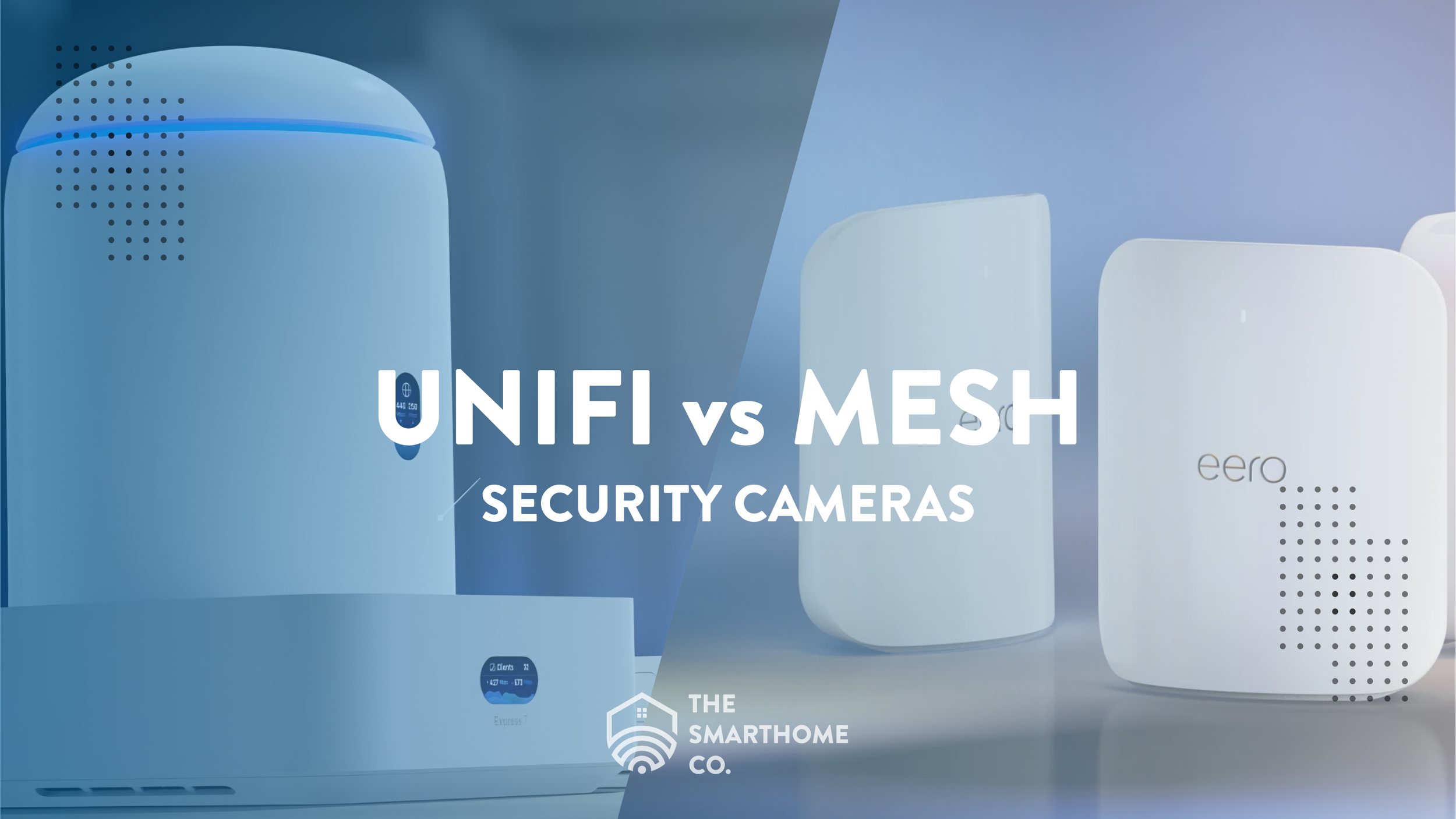
What this article covers
- How UniFi differs from consumer mesh Wi-Fi systems.
- When mesh Wi-Fi is enough and when UniFi becomes the better fit.
- Why small businesses often need more control, visibility, segmentation, and scalability.
- How The SmartHome Co. designs UniFi systems around real spaces, real users, and long-term reliability.
Mesh Wi-Fi is simple. UniFi is more intentional.
Consumer mesh systems are built to be easy. You buy a kit, plug in the nodes, follow an app, and hope the coverage improves. For some homes, that is enough. The simplicity is the selling point.
UniFi is different. A UniFi system separates the network into purpose-built components: a gateway, switches, access points, cameras, and management software. That gives a technology integrator more control over coverage, performance, security, expansion, and troubleshooting.
Quick answer
Mesh Wi-Fi is best for simple home coverage improvements. UniFi is better when you need stronger reliability, wired access points, guest networks, device visibility, camera integration, small business features, and a network that can grow over time.
What consumer mesh does well
Mesh is not a bad category. It solves a real problem for many homeowners: one router in one corner of the home usually cannot provide clean coverage everywhere. A good mesh system can improve a smaller or moderately sized home without running new cable.
Easy setup
Most mesh systems are designed for app-based setup and basic home use.
Flexible placement
Nodes can be moved around the home as long as they have power and a decent signal path.
Good for simple needs
A mesh system can be enough for basic streaming, browsing, phones, tablets, and light smart home usage.
Lower upfront complexity
Mesh usually requires less planning than a professionally integrated network.
Where mesh starts to fall short
Mesh becomes less ideal when the home or business needs stronger performance, cleaner management, wired access points, more cameras, guest Wi-Fi, network segmentation, outdoor coverage, or long-term scalability.
We commonly see mesh systems struggle when people add more devices over time. A setup that felt fine with phones and a few TVs may not feel fine once the property adds video doorbells, cameras, smart speakers, thermostats, laptops, tablets, gaming systems, and work-from-home equipment.
- Wireless backhaul can create performance bottlenecks.
- Node placement is often based on outlets instead of coverage design.
- Advanced network visibility and control may be limited.
- Small businesses may outgrow basic consumer features quickly.
- Camera systems, smart devices, and business equipment may need a stronger foundation.
What UniFi offers
UniFi gives homeowners and small businesses a more structured approach. Instead of one consumer router trying to handle routing, Wi-Fi, switching, security, and management all by itself, UniFi systems can be designed around the property and the devices that matter most.
Gateway
Manages routing, firewall rules, remote access, VPN options, and the core network connection.
Switches
Distribute wired connections to access points, cameras, TVs, offices, workstations, and network devices.
Access points
Provide Wi-Fi from better locations, often ceiling or wall-mounted, instead of relying on a box in a corner.
Management interface
Gives better visibility into connected devices, network health, client activity, and system performance.
Why small businesses often move toward UniFi
Small businesses need technology that works without becoming a daily distraction. A retail shop, office, warehouse, salon, church, studio, or restaurant may need staff Wi-Fi, customer Wi-Fi, cameras, point-of-sale devices, printers, office computers, cloud tools, and phones all working reliably.
UniFi can support those needs with better management, cleaner expansion, and more professional features than most consumer mesh systems.
- Separate guest Wi-Fi from business devices.
- Support PoE cameras and access points.
- Improve visibility into network health and connected devices.
- Scale from a small setup to a more complete business network.
- Integrate networking and surveillance planning more cleanly.
Why homeowners choose UniFi
Homeowners often choose UniFi when they are tired of routers that need restarts, mesh systems that underperform, cameras that go offline, and smart devices that feel inconsistent. The appeal is not just speed. It is control, placement, reliability, and a cleaner foundation.
UniFi can be a strong fit for larger homes, work-from-home setups, outdoor spaces, home theaters, smart homes, and properties with multiple cameras or access points.
Integrator perspective
The value of UniFi is not just the hardware. The value is in proper design, placement, wiring, configuration, documentation, and client education. That is where a technology integrator makes the system easier to live with.
When mesh is still the better option
Not every home or business needs UniFi. If the space is small, the device count is light, wiring is not realistic, and the client wants the simplest possible setup, a good mesh system may be enough.
The best recommendation depends on goals, budget, wiring access, support expectations, and how much reliability matters. A good integrator should not oversell UniFi when a simpler solution fits the space.
What we look at before recommending UniFi
Before we recommend UniFi, we look at the building layout, internet service, wiring options, camera locations, office needs, outdoor coverage, number of users, future growth, and how much visibility the client wants. A small business may need VLANs, guest Wi-Fi, and PoE cameras. A homeowner may mainly need reliable access points, clean wiring, and a network that supports streaming, smart devices, and home offices.
The technology should fit the property. That is the difference between installing equipment and designing a system.
Final thoughts
Consumer mesh Wi-Fi is convenient. UniFi is more scalable, more visible, and more flexible for homes and businesses that need stronger performance and better long-term reliability.
The SmartHome Co. helps clients choose the right level of technology instead of forcing one solution onto every property.
Need a better network for your home or small business?
The SmartHome Co. designs, integrates, configures, and supports UniFi Network systems for homes and small businesses across Metro Atlanta. We help with access points, switches, gateways, Ethernet wiring, guest Wi-Fi, cameras, and long-term network planning.
Explore UniFi Integration Services